
OF FAITH AND MIRACLES
It happens to us all — but it happened to Lazarus earlier than expected. Lazarus died. We see the story in John 11:1-44.
Jesus was not there, but was a distance away, and news came to Him from the sisters Martha and Mary that Lazarus was sick. Hearing this news, Jesus stayed where He was for two more days. When He eventually arrived at the scene, Lazarus had been in the tomb for four days. Therefore even if Jesus had hurried to his aid immediately He’d heard of the illness, He would have arrived only two days earlier, so that Lazarus would have been in the tomb for two days. In other words, Jesus would still have been “too late”.
However, Jesus knew from the very beginning what the Father had in mind. He immediately said, “This sickness will not end in death. No, it is for God's glory so that God's Son may be glorified through it.” (John 11:4) After the two days, He told the disciples euphemistically, “Our friend Lazarus has fallen asleep; but I am going there to wake him up.” They misunderstood, so then he told them plainly, “Lazarus is dead, and for your sake I am glad I was not there, so that you may believe.” (John 11:11,14,15)
The dividing line between a healing and a miracle is not always clear, but this was to be a miracle. Jesus knew the Father’s intention from the start, yet some things had to be worked out in terms of the co-operation of the participants.
We are taught to pray, "Your kingdom come, your will be done on earth and it is in heaven." (Matthew 6:10). If His will is always and automatically done, then these are empty words and the prayer is vacuous. Somehow there is room for our response of moving in faith to bring His expressed will into actuality.
So then, at God's expressed intention to do a miracle, how do we interact in faith?
The Condition for God’s Miracle: Moving in Faith
By the “tomb time”, the initial stage was complete. The sisters had applied to Jesus (v3) and had made a faith confession (v21-27, 32). Often we do that, think it’s enough, and stop. But we must continue to move in faith.
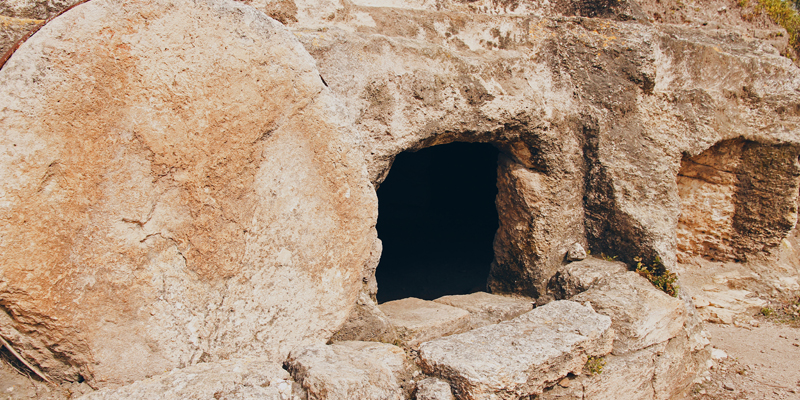
Standing there at the tomb in compassion and in the emotion of the moment, Jesus instructed, “Take away the stone.” It was an outward step that had to happen. Often referred to as “breaking the natural”, it was a step of faith. And yet, for all her faith confession, Martha immediately voiced a practical objection: “But, Lord, by this time there is a bad odour, for he has been there four days.” It was true, but it was natural thinking on the natural plane. Jesus reminded her of the faith dimension, “Did I not tell you that if you believed, you would see the glory of God?”
Typically for unbelievers, seeing is believing. Jesus had earlier told a concerned father, “Unless you people see miraculous signs and wonders, you will never believe.” (John 4:48). However for believers the phrase is reversed: believing is seeing. Yet neither is an absolute rule. For many people believe as best they know how, and do not see a miracle; while many others see, and do not believe.
The stone was removed, and (in all likelihood) there was indeed a bad odour. Faith must press through natural conditions, even though the circumstances scream, “told you so!” or, “it’s not working.”
Faith is outward, not inward; active, not passive. They would have looked foolish if it hadn’t worked precisely because they’d removed the stone. Faith is not “positive thinking”; faith acts. Faith is a choice we make, an action we take, on the basis of the Word of God.
The Goal of God’s Miracle: God’s Son Glorified
The style of the next moments in the narrative is not spectacular, although Jesus is aware of the spectators. He came to a place outside the village. First Martha, and then Mary went to Him and dialogued. The Jews followed Mary uninvited. In talking to the sisters, Jesus was deeply moved, a fact the crowd observed, and discussed it among themselves (v36,37).
Jesus neither raised a crowd nor played to the crowd. Impressing the crowd was not His main goal. As would happen later at Pentecost, there was no marshalling of a crowd to witness the moving of God. God simply moved, and the crowd became aware of it.
Already clear that this was to be for God’s glory and that He was to be glorified as God’s Son through it, Jesus knew that the matter was already settled — “Father, I thank you that you have heard me.” Apparently, He did not need to say anything at all in prayer, but did so in awareness of and for the benefit of the spectators (v41,42), so that on the one hand they would not think that He had done it, but the Father to whom He’d prayed; and on the other that they would believe that He was sent from the Father.
Jesus models something for us here. When we as God’s sons are involved in miracles, we should not play to the gallery, nor act in such a way that it seems we ourselves are doing something laudable or spectacular. It’s all about God and His glory. We may function as the mouthpiece, but He is the one sounding the trumpet.
The showman would have entered the cave and emerged a few moments later with a fully revived, unwrapped and cleaned-up Lazarus, to whoops and shouts from the crowd and with appropriate acknowledgment and bowing, leaving them wondering, “How did he do that?” But there was no such spectacular performance from Jesus, only the words, “Lazarus, come out!” And the man who had been dead for four days stumbled out of the tomb unaided, his face, hands and feet still wrapped, for the crowd to unbind and release him. No tricks, no gimmicks, and God gets the glory.
As a result many of the Jews put their faith in Jesus (v45). Miracles don’t achieve evangelism, but they may lead to evangelism. Miracles achieve interest, and in some cases, openness. But faith comes by hearing the word of Christ, not by the miracle (Romans 10:17).
The outcome here was evangelistic, glorifying God and God’s Son. It’s not the we use signs and wonders for evangelism, but that God does signs and wonders for the purpose of evangelism.
The Alternative to God’s Miracle
The miraculous is at God’s initiation. But if we do not move in faith, we will not see it. We will miss the miracle, and yet we will not be aware of missing out, for we will have no knowledge of what could have been. In that case, we are likely to interpret what was supposed to be a miracle to glorify God as a “bad experience” — and we may even blame God for it.
What if Martha and Mary had not co-operated? What if they had not removed the stone? God would not have been glorified, but they would not have known. People would not have believed, but they would not have known either. Lazarus would still have been dead.
If they had not moved in faith, they would have interpreted what was meant to be a mighty miracle of God as a bad experience — Lazarus had died young — and they might even have blamed God.
Of Faith and Miracles
Especially in time of need, come to Jesus, confess faith in Him — and then move in faith. This involves obedience and action. It may involve stepping out, breaking the natural, taking away the stone. We must persist and press on through the smell, the social awkwardness and the negative indicators. Our concern must be for God’s Son to be glorified.
Who knows how many times in our past lives we’ve been in a situation where God had in mind a miracle — but it did not happen — because we did not move in faith?
There is no “magic key” that unlocks all negative situations and guarantees that things always work out as we would wish. Yet there are situations, and perhaps more than we think, which remain negative, but which God had intended to transform.
Unless we move in faith, it may well be true for us that God had something in mind that was miraculous and glorious, but all that happened and all that we saw was a bad experience, where something went wrong that was not put right. And, without knowing it, we missed out, because having allowed thoughts of smells and other practical matters to determine our responses, we failed to move in faith.
Copyright © 2007, 2025 by George Alexander. All rights reserved.
George Alexander, 19/02/2026